
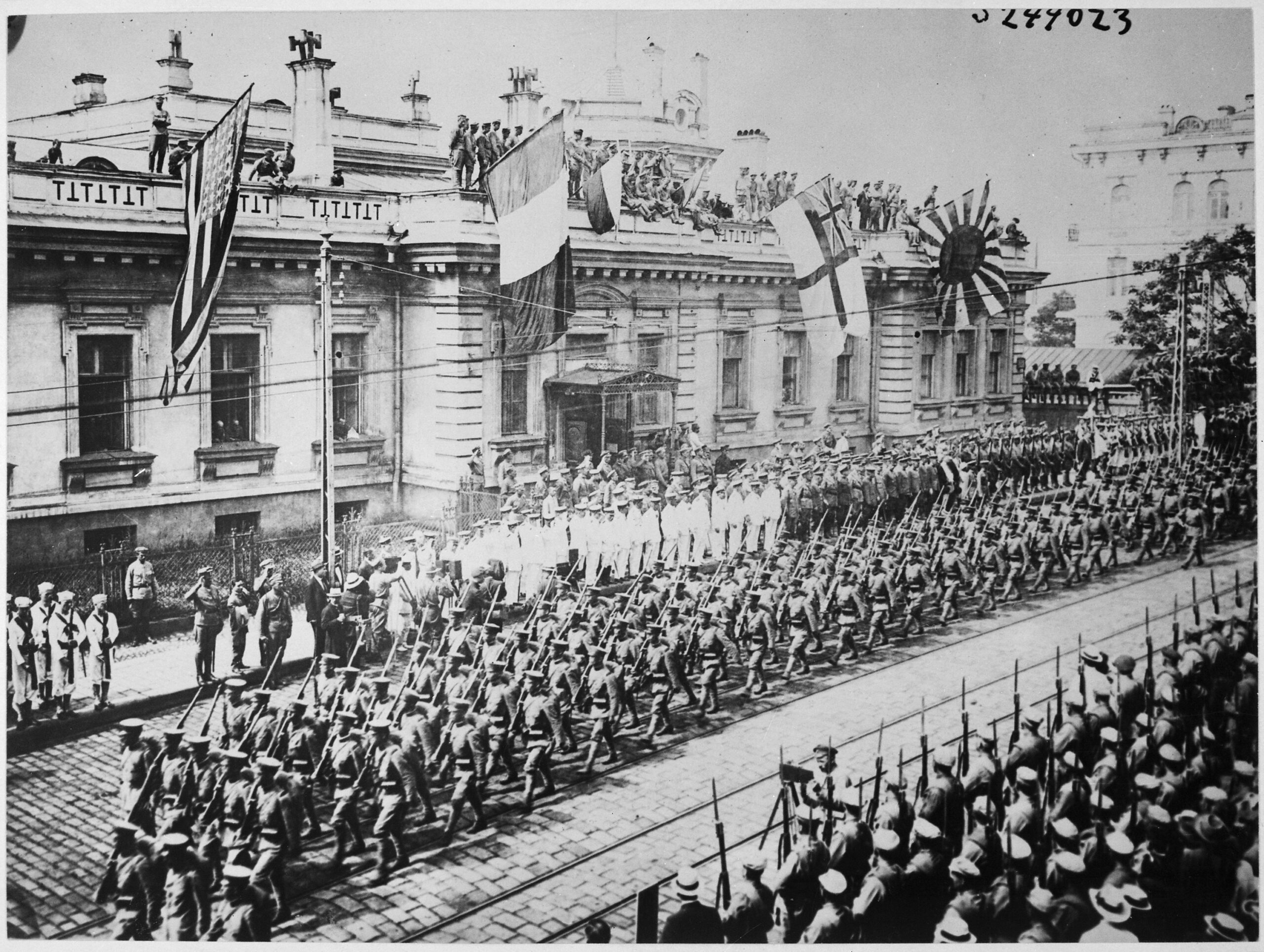
The relationship between the United States and the USSR from 1917 to 1941
Background and Context
The relationship between the United States and the USSR from 1917 to 1941 is a dramatic arc moving from open military conflict and ideological hostility to a cautious diplomatic recognition, followed by renewed distrust, and finally, a desperate military alliance forged by a common enemy.
Here is a breakdown of the key phases in US-Soviet relations during this period.
1917–1933: The Era of Non-Recognition
For the first 16 years of the Soviet Union’s existence, the United States refused to diplomatically recognize the Bolshevik government. This period was characterized by ideological fear and “unofficial” interaction.
- The Russian Revolution (1917): The US was initially hopeful that the overthrow of the Tsar would lead to a democratic Russia. However, the Bolshevik seizure of power in November 1917 and their subsequent withdrawal from WWI (Treaty of Brest-Litovsk) was viewed by Washington as a betrayal of the Allied cause.
- Military Intervention (1918–1920): The US did not just ignore the Bolsheviks; they fought them. President Woodrow Wilson sent roughly 13,000 American troops to Russia as part of an Allied intervention.
- The Polar Bear Expedition: ~5,000 US troops landed in Archangel (North Russia) to protect supplies and fight Bolshevik forces.
- Siberian Intervention: ~8,000 US troops landed in Vladivostok to monitor Japan’s expansion and secure the Trans-Siberian Railway.
- Famine Relief (1921–1923): Despite the lack of diplomatic ties, the US provided massive humanitarian aid during the Russian Famine of 1921. The American Relief Administration (ARA), led by Herbert Hoover, fed millions of Russians, a complex mix of humanitarianism and a desire to showcase the superiority of capitalism.
- Corporate “Foreign Policy”: While the US government stood back, American businesses surged forward. In the 1920s, companies like Ford and General Electric played a massive role in Soviet industrialization, selling tractors and building factories.
1933: The Turning Point — Diplomatic Recognition
By 1933, the global context had changed. The Great Depression made Soviet markets attractive to American business, and the rise of Japan in the Pacific gave both nations a common strategic concern.
- The Roosevelt-Litvinov Agreements: President Franklin D. Roosevelt broke with precedent and opened negotiations with Soviet Foreign Minister Maxim Litvinov.
- The Deal: The US officially recognized the USSR in exchange for Soviet promises to:
- Refrain from spreading communist propaganda in the US
- Allow religious freedom for Americans in the USSR.
- Negotiate the repayment of Tsarist-era debts (a point that would later cause friction).
1933–1939: Strained Relations & Disillusionment
The optimism of 1933 quickly evaporated. The “marriage of convenience” turned sour due to domestic Soviet brutality and broken promises.
- The Debt Dispute: The “gentleman’s agreement” on debt repayment collapsed. The Soviets refused to pay old Tsarist debts unless they received new loans, which the US Congress (via the Johnson Act) prohibited.
- The Great Terror (1936–1938): Stalin’s show trials and purges of his own military and political elite shocked the American public and eroded any moral standing the USSR had gained.
- Diplomatic Freeze: By 1938, relations were effectively frozen. The US Ambassador to Moscow, Joseph Davies, was one of the few who argued that the USSR would be essential in a war against Hitler, but he was an outlier.
1939–1941: The Low Point
Relations hit rock bottom following the failure of collective security in Europe.
- Molotov-Ribbentrop Pact (August 1939): The shock non-aggression pact between Nazi Germany and the USSR stunned Washington. The US now viewed the USSR not as a potential partner against Hitler, but as his totalitarian accomplice.
- The Winter War (1939–1940): When the USSR invaded Finland, American public sentiment was overwhelmingly pro-Finnish.
- FDR instituted a “moral embargo” on the export of aircraft and materials to the USSR.
- The USSR was expelled from the League of Nations, with tacit US approval.
- However, FDR stopped short of breaking diplomatic relations, wishing to keep a window open in case the Soviet-German alliance cracked.
1941: The “Grand Alliance” Begins
The relationship changed overnight due to German aggression.
- Operation Barbarossa (June 1941): Nazi Germany invaded the USSR. Despite deep anti-communist sentiment, US leadership adopted a pragmatic stance: “The enemy of my enemy is my friend.”
- Lend-Lease Extension: Initially, the US provided aid on a “cash and carry” basis. By October 1941, the US formally extended Lend-Lease to the Soviet Union, beginning a massive logistical lifeline that would supply the Red Army with trucks, aircraft, and food for the duration of the war.
- Pearl Harbor (December 1941): When the US entered the war, the two nations officially became military allies, shelving their ideological differences to defeat the Axis powers.
Summary Table: Evolution of Relations
| Period | State of Relations | Key Event |
| 1917 – 1933 | Hostile/Non-existent |
US troops in Russia; Red Scare; No recognition. |
| 1933 | Cautious Optimism | FDR recognizes USSR; Trade hopes. |
| 1934 – 1939 | Strained |
Stalin’s Purges; Debt disputes. |
| 1939 – 1941 | Near-Hostile |
Nazi-Soviet Pact; Soviet invasion of Finland. |
| Late 1941 |
Allied
|
Lend-Lease begins; US enters WWII |
The Lend Lease Act and the Red Scare
1917- 1941 An overview
——————————————————————————————-
Lend-Lease: Fueling the Red Army (1941–1945)
While the Soviet Union provided the vast majority of the manpower (and suffered the highest casualties) to defeat Nazi Germany, the United States provided the critical mobility and logistics that allowed the Red Army to sustain its offensives.
By the end of the war, the US had shipped approximately $11.3 billion (about $180 billion today) in supplies to the USSR.
- Mobility (The “Studebaker” Factor):
- The most crucial contribution was not tanks, but trucks. The US sent over 400,000 trucks and jeeps (mainly Studebakers and Dodge WC series). Before this aid, the Red Army relied heavily on horse-drawn logistics. American trucks allowed Soviet forces to advance hundreds of miles quickly during their 1944–1945 offensives.
- Aviation:
- The US sent approximately 14,000 airplanes. A notable favorite was the P-39 Airacobra. While American pilots disliked it for high-altitude combat, Soviet pilots loved it for low-altitude tank busting on the Eastern Front. Famous Soviet aces, including Alexander Pokryshkin, scored nearly all their kills in American-built P-39s
- Food and Raw Materials
- When the Nazis captured the “breadbasket” of Ukraine, the USSR faced mass starvation. The US shipped 4.5 million tons of food, largely in the form of canned meat (spam and tushonka), which became a staple of the Soviet soldier’s diet. Additionally, the US provided 107,000 tons of cotton and enough leather to make 15 million pairs of army boots
- Rail and Industry:
- The US rebuilt the Soviet rail network, supplying 1,900 locomotives and 11,000 railcars, ensuring that supplies could actually reach the front lines.
The Domestic Front: The “Red Scare” (1917–1941)
While the US government eventually allied with Stalin abroad, it remained deeply hostile to communism at home. This era saw two distinct waves of anti-communist political repression
- Phase 1: The First Red Scare (1917–1920) Following the Bolshevik Revolution, hysteria swept the US, conflating labor strikes, anarchism, and immigrants with a Bolshevik plot to overthrow the American government.
- The Palmer Raids (1919–1920): After a series of anarchist bombings (one of which damaged Attorney General A. Mitchell Palmer’s home), the Justice Department launched raids arresting over 3,000 people.
- The “Soviet Ark”: In December 1919, the US government deported 249 resident aliens (including famous anarchist Emma Goldman) to Russia aboard the USS Buford, solely for their political beliefs.
- Legislative Crackdown: The Espionage Act (1917) and Sedition Act (1918) were aggressively used to silence socialists and critics of capitalism.
Phase 2: The Institutionalized Fear (1938–1941)
As the 1930s progressed, anti-communism shifted from temporary hysteria to a permanent political tool, often used by conservatives to attack FDR’s “New Deal” as “creeping socialism.”
- Formation of HUAC (1938): The House Un-American Activities Committee (HUAC) was created under Congressman Martin Dies. While nominally hunting both Nazis and Communists, it focused heavily on investigating left-wing influence in unions, the government, and Hollywood.
- The Smith Act (1940): This law made it a criminal offense to advocate the violent overthrow of the government. It would later become the primary legal weapon used to prosecute the leadership of the Communist Party USA during the Cold War.
This period sets the stage for the Cold War: The US was arming the Soviet Union to survive Hitler, while simultaneously building the legal and political machinery (HUAC, Smith Act) to fight communists at home.
Would you like to know how the American public reacted to this contradiction, or explore how the “Grand Alliance” fell apart so quickly after 1945?