
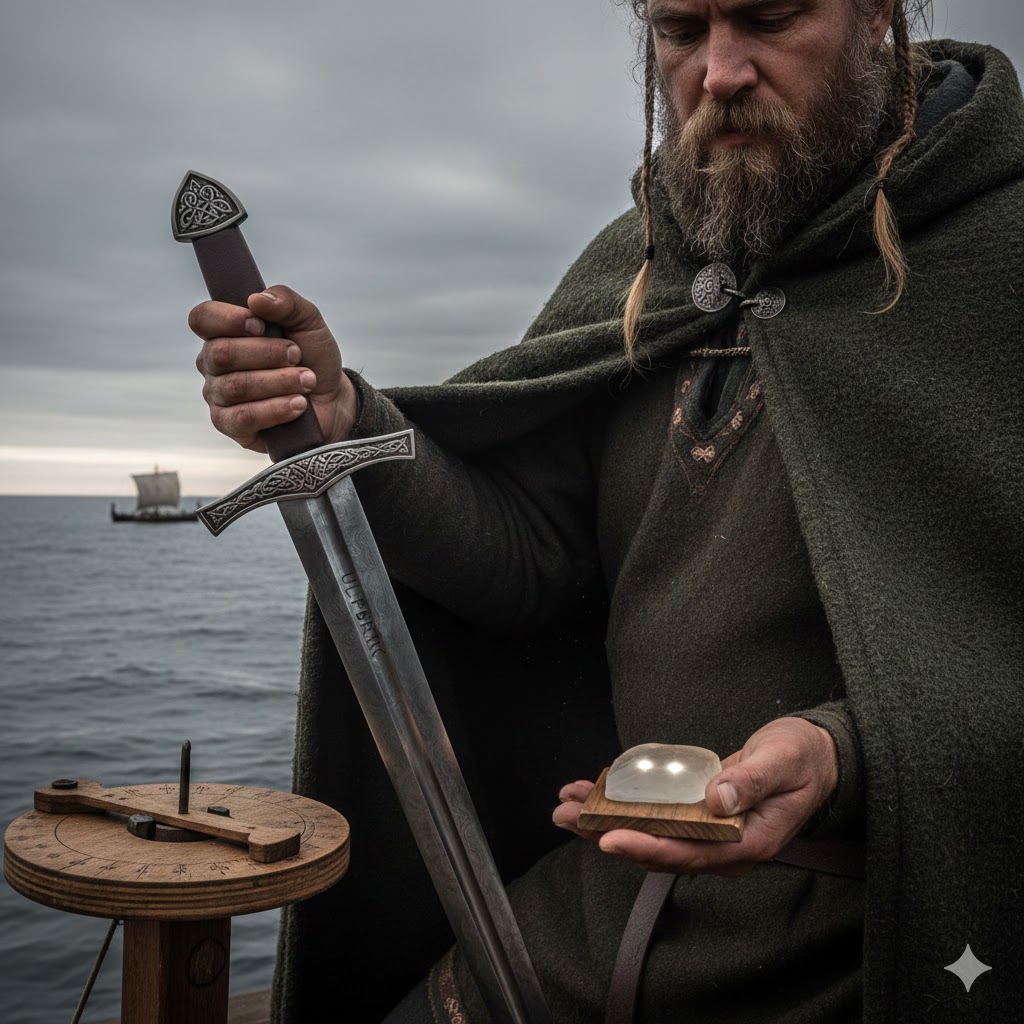
1. The Ulfberht Sword: Medieval “Nano-Tech”
The Ulfberht was the “Ferrari” of the Viking world. While most swords of the era were made of “pattern-welded” iron (twisting bars of iron together, which were often brittle), the Ulfberht was made of crucible steel.
-
The Science: To make this steel, the iron had to be heated to roughly 1,500°C (about 2,730°F). This allowed the slag (impurities) to be removed and carbon to be distributed evenly.
-
The Mystery: European blacksmiths wouldn’t figure out how to reach these temperatures on a large scale until the Industrial Revolution.
-
The Connection: It is widely believed the Vikings brought the raw “wootz” steel or the technique back from the Middle East via the Volga trade route.
-
The Advantage: These swords were stronger, lighter, and wouldn’t get stuck in an opponent’s shield or snap during a cold winter battle.
2. Navigation: The Sunstone & The Compass
Because the North Atlantic is notoriously foggy and the sun can stay below or near the horizon for long periods, traditional “star-gazing” wasn’t always an option.
The Sunstone (Sólarsteinn)
Vikings used Icelandic Spar (a type of calcite). This crystal has a property called double refraction.
-
How it worked: When you look through the crystal, it splits the light into two beams. By rotating the stone until the two beams are equal in brightness, a navigator could pinpoint the location of the sun even through thick clouds or after sunset.
The Sun Compass
This wasn’t a magnetic compass (which points North), but a bearing dial.
-
The Innovation: It used a central pin (gnomon) that cast a shadow onto a wooden disk carved with “horizon marks.”
-
The Math: By tracking the shadow’s tip across the disk, they could determine their latitude with remarkable accuracy. Even if they were blown off course by a storm, they could “find” their line of latitude again to reach Greenland or Vinland (North America).
3. The “Wool” Technology
It sounds less “cool” than swords, but the Vikings’ ability to survive the North Atlantic was actually due to textile innovation.
-
Waterproofing: They developed a way to treat wool with lanolin (sheep oil) and fish oil, creating “sail-cloth” that didn’t rot in salt water and heavy cloaks that were essentially the first “Gore-Tex.” Without this, their sails would have become waterlogged and heavy, sinking or slowing the ships.
Fun Fact: An Ulfberht sword was so valuable that it was often worth the price of 15 to 20 milk cows. It was more than a weapon; it was a massive flex of wealth and global connections.