
The Weimar Republic’s first five years (1919–1923) were a “crisis years” period where the new democracy nearly collapsed multiple times. It struggled because it was born out of defeat, burdened by a punitive peace treaty, and attacked from both the radical left and the extreme right, all while facing economic disintegration.
The following breakdown details why the Republic faced such an uphill battle for survival.
The “Poisoned Chalice” of Defeat
The Republic was declared two days before the armistice ended World War I. This timing meant the new democracy—rather than the Kaiser or the military generals who had actually lost the war—took the blame for the defeat.
- The “Stab in the Back” Myth (Dolchstoßlegende): Right-wing nationalists falsely claimed the German army was undefeated on the battlefield but was betrayed at home by jews, socialists, and democrats. This myth delegitimized the Republic from day one.
- The “November Criminals”: The politicians who signed the Armistice were branded traitors, making the very idea of democracy synonymous with betrayal in the eyes of many Germans.
The Treaty of Versailles (1919)
The terms of the peace treaty were viewed universally in Germany as a Diktat (dictated peace). It crippled the new government’s popularity because they were forced to sign it or face invasion.
- Article 231 (War Guilt Clause): Forced Germany to accept full moral responsibility for the war, a national humiliation.
- +1
- Reparations: The requirement to pay £6.6 billion deprived the new state of resources needed for recovery.
- Territorial Losses: Loss of 13% of its land (including the resource-rich Saar and Upper Silesia) damaged the economy and national pride.
Political Extremism and Violence
The Republic was besieged by uprisings from both sides of the political spectrum. It survived only by relying on the army and right-wing paramilitaries, which undermined its democratic authority.
| Year | Event | Threat Source | Outcome |
| 1919 | Spartacist Uprising | Far Left (Communists) | Attempted communist revolution in Berlin. Crushed by the Freikorps (right-wing ex-soldiers) on government orders. Leaders Rosa Luxemburg and Karl Liebknecht were executed. |
| 1920 | Kapp Putsch | Far Right | The Freikorps marched on Berlin to overthrow the government. The army refused to fire on them (“Reichswehr does not fire on Reichswehr”). The coup failed only because a general strike by workers paralyzed the capital. |
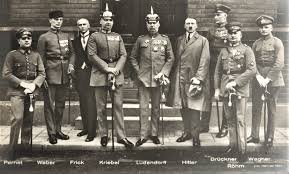
| 1923 | Munich Putsch | Far Right (Nazis) | Adolf Hitler and the Nazis attempted to seize power in Munich. It failed, but judges gave Hitler a lenient sentence, highlighting the judiciary’s right-wing bias. |
Critical Insight: The Republic was in the unique position of being a “democracy without democrats.” Many judges, army generals, and civil servants actively despised the system they served, often punishing left-wing violence harshly while letting right-wing terrorists off lightly.
The Economic Apocalypse (1923)
The struggle for survival peaked in 1923, the “year of crisis,” due to the convergence of reparations and hyperinflation.
- Invasion of the Ruhr: When Germany fell behind on coal reparations, French and Belgian troops occupied the Ruhr (Germany’s industrial heartland).
- Passive Resistance: The German government ordered workers to strike but continued to pay them by printing money.
- Hyperinflation: The reckless printing of money caused the currency to collapse.17 By November 1923, a loaf of bread cost 200 billion marks.Middle-class savings were wiped out, radicalizing the middle class and permanently destroying their trust in the democratic state.
Constitutional Flaws
The Weimar Constitution was progressive but contained fatal structural flaws that made early governance difficult:
- Proportional Representation: This voting system allowed many tiny parties to enter the Reichstag, making stable majorities impossible. This led to weak, short-lived coalition governments that struggled to pass laws.
- Article 48: This allowed the President to rule by emergency decree without Parliament. While intended for emergencies, it became a crutch for leaders to bypass democratic deadlock, accustoming the public to authoritarian rule.
Summary
The Weimar Republic struggled because it faced a “perfect storm”: it was blamed for a war it didn’t lose (in the public mind), forced to pay a bill it couldn’t afford, and defended by an army that wanted it to fail. It survived 1923 only because the alternative—total anarchy—was more terrifying to the elites than democracy.