
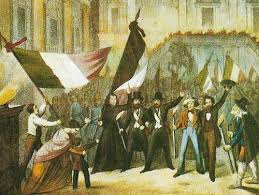
I. The Aftermath of Napoleon and the Congress of Vienna (1815)
The entire period begins with the definitive defeat of Napoleon Bonaparte in 1815. His 20 years of conquest had totally destabilized Europe. The major European powers needed to clean up the mess and prevent it from ever happening again.
What was the Congress of Vienna?
The Congress of Vienna (1814–1815) was a meeting of European diplomats and rulers, primarily aimed at restoring peace and order after the Napoleonic Wars.
Key Goals of the Congress:
- Legitimacy: Restoring the ‘legitimate’ ruling families (the old monarchies) who had been overthrown by Napoleon. (Example: Bringing the Bourbon King back to the throne of France.)
- Balance of Power: Ensuring that no single country (especially France) could dominate Europe again. They did this by strengthening France’s neighbours.
- Containment: Creating ‘buffer states’ around France to contain any future revolutionary ideas or military aggression.
The Big Five Players (The Great Powers):
- Austria: Represented by Prince Klemens von Metternich (The host and the most influential conservative figure).
- Great Britain: (Wanted naval power and trade).
- Russia: (Wanted influence in Eastern Europe).
- Prussia: (Wanted territory in Germany).
- France: (Surprisingly, allowed a seat to ensure stability).
Quick Review: The Congress of Vienna was all about stability, preventing revolution, and putting kings back on their thrones. It was a victory for Conservatism.
The Concert of Europe (1815–c. 1850s)
The Concert of Europe was the system established by the Congress. It wasn’t a formal written treaty, but a promise by the Great Powers to meet regularly to discuss issues and intervene militarily if necessary to crush revolutions.
Think of the Concert of Europe like a Neighbourhood Watch group: They agree to patrol the area (Europe) and deal with any troublemakers (revolutionaries) before they cause too much damage.
Key Takeaway: The Congress of Vienna successfully maintained peace between the Great Powers for about 40 years, but it ignored the rising popular forces of nationalism and liberalism, setting the stage for major clashes later.
II. The Clash of Ideologies: Conservatism, Liberalism, and Nationalism
The stability imposed by Metternich and the Congress was constantly challenged by powerful new political ideas, often called the ‘isms’. Understanding these three concepts is essential for understanding the entire 19th century.
1. Conservatism
Core Beliefs:
- Upholds traditional institutions: monarchy, aristocracy, and the established church.
- Society should change slowly, if at all.
- Hated the French Revolution and feared disorder.
- Key Figure: Metternich.
Did you know? Many Conservatives believed that people were naturally unequal and that the elites were the only ones fit to govern.
2. Liberalism
Core Beliefs:
- Values individual freedom (liberty).
- Demands written constitutions, elected parliaments, and protection of rights (like speech and assembly).
- Economic Liberals believed in laissez-faire (free markets, minimal government involvement).
- Crucially, early Liberals usually believed suffrage (the right to vote) should be limited to men who owned property.
Common Mistake to Avoid: Liberalism in the 19th century is not the same as modern political liberalism. It was primarily concerned with property rights and limiting the power of the king.
3. Nationalism
Core Beliefs:
- The idea that a person’s chief loyalty should be to their nation—people who share a common culture, language, and history—rather than to a king or an empire.
- Nationalists demanded that each nation should have its own sovereign, independent state (a nation-state).
Analogy: Imagine you are part of a school club (your nation). Nationalism means you want your club to be completely independent, write its own rules, and govern itself, rather than being ruled by the overarching school administration (the multinational empire).
Nationalism was the greatest threat to the multinational Austrian, Ottoman, and Russian Empires.
Memory Aid (The Isms):
C – Crowns (Monarchs)
L – Liberty (Constitutions)
N – Nation (Shared Culture)
Key Takeaway: The 19th century was a struggle between Conservatives trying to suppress these new ideas and Liberals/Nationalists fighting to implement them, often leading to revolution.
III. Revolutionary Challenges (1820s–1848)
Despite the best efforts of the Concert of Europe, the ‘isms’ repeatedly sparked uprisings.
The Revolutions of 1830
- France: The Bourbon monarchy (restored in 1815) was overthrown again and replaced by the slightly more liberal King Louis Philippe.
- Belgium: Successfully broke away from Dutch rule, demonstrating the power of nationalism to create new states. This was a crack in the Congress System’s foundations.
The Revolutions of 1848: “The Springtime of Peoples”
Don’t worry if this seems complicated; the key is to understand that these revolutions were simultaneous, widespread, and ultimately failed almost everywhere.
Why were the Revolutions so Widespread?
A combination of factors led to these massive uprisings:
- Economic Distress: Crop failures (like the potato blight) and economic depression caused widespread starvation and unemployment.
- Liberal Demands: Middle classes demanded constitutional government and voting rights.
- Nationalist Demands: Groups like Hungarians, Czechs, and Italians demanded autonomy or independence from their imperial rulers (especially Austria).
Why Did They Fail?
In almost every location (France being a temporary exception), the revolutions were ultimately crushed by conservative forces.
- Lack of Unity: Liberals and Nationalists often fought each other. Once liberals got constitutional freedoms, they refused to support the social demands of the working classes.
- Imperial Army Strength: The Austrian and Prussian armies remained loyal and were powerful enough to brutally suppress the disparate revolutionary forces.
- Internal Divisions: In places like the German states, nationalists couldn’t agree on who should lead a unified Germany (Prussia or Austria?).
Key Takeaway: The 1848 revolutions showed that while popular forces (Nationalism and Liberalism) were powerful, they needed strong, centralized leadership and military power to succeed against the established conservative order.
IV. The Triumph of Nationalism: The Age of Unification (1850s–1871)
After 1848, the methods used to achieve unification changed. Instead of romantic, popular revolutions, strong leaders used calculated warfare and political maneuverings—a strategy known as Realpolitik—to achieve their goals.
1. The Unification of Italy (The Risorgimento)
Before 1860, Italy was a patchwork of small states, many controlled directly or indirectly by Austria.
Key Figures and Roles:
- Camillo Cavour (The Brains): Prime Minister of Piedmont-Sardinia (the strongest independent Italian state). He was the practical politician who used diplomacy and military alliances (Realpolitik) to drive Austria out.
- Giuseppe Garibaldi (The Sword): A romantic nationalist who led a volunteer army (the ‘Red Shirts’). He conquered the Kingdom of the Two Sicilies (Southern Italy) and then handed control over to Cavour, prioritizing unification over his own power.
- Victor Emmanuel II (The Crown): King of Piedmont-Sardinia, who became the first King of unified Italy (1861).
Step-by-Step Unification Process:
- Cavour’s Diplomacy (1850s): He skillfully allied with France to defeat Austria and gain territory in Northern Italy.
- Garibaldi’s Invasion (1860): Garibaldi took the South; Cavour, fearing a republican takeover, quickly moved his forces south.
- The Merger (1861): Garibaldi met Victor Emmanuel II and symbolically ceded his conquered territories, allowing the new Kingdom of Italy to be proclaimed.
Did you know? Rome was not included in unified Italy until 1870, largely because French troops protected the Pope until they were needed elsewhere (during the Franco-Prussian War).
2. The Unification of Germany
Germany, like Italy, was a collection of many small states, dominated by two major powers: the Catholic Austrian Empire and the Protestant Kingdom of Prussia.
Key Figure: Otto von Bismarck
Bismarck, the Minister-President of Prussia, was the ultimate practitioner of Realpolitik.
- Realpolitik Definition: A policy of using any means necessary—including war, deception, and cynical diplomacy—to achieve national goals. It focuses on power, not morality.
- Famous Quote: Bismarck declared that great questions would be solved not by speeches and majority resolutions, but by “Blood and Iron.” This meant military power and industrial strength, not liberal ideals.
Step-by-Step Unification Process: The Three Wars
Bismarck masterminded three short, decisive wars to eliminate rival powers and unite the German states under Prussian leadership:
- The Danish War (1864): Prussia allied with Austria to gain territory from Denmark. This created a tension point between Prussia and Austria.
- The Austro-Prussian War (Seven Weeks’ War, 1866): Bismarck maneuvered Austria into a war. Prussia won quickly due to superior organization and technology. Result: Austria was permanently excluded from German affairs. Prussia formed the North German Confederation.
- The Franco-Prussian War (1870–71): To bring the remaining independent Southern German states into the fold, Bismarck needed a common enemy—France. He skillfully provoked Napoleon III into declaring war. Prussia won decisively.
The Final Act: The German Empire was proclaimed in the Hall of Mirrors at Versailles (France) in January 1871. Kaiser Wilhelm I (of Prussia) became the German Emperor.
Key Takeaway: By 1871, both Italy and Germany were unified through the strategic use of military force (Blood and Iron) and political maneuvering (Realpolitik), replacing the idealist dreams of 1848 revolutionaries.
Summary of Key Dates (1805–1871)
Memorizing the sequence helps you structure your essays!
- 1815: Congress of Vienna establishes the conservative order.
- 1830: Revolutions in France and Belgium show the first major cracks.
- 1848: Widespread failure of Liberal and Nationalist revolutions across Europe.
- 1861: Kingdom of Italy is proclaimed (Cavour/Garibaldi).
- 1866: Austro-Prussian War excludes Austria from German affairs (Bismarck).
- 1871: German Empire is proclaimed after defeating France (Bismarck’s ultimate triumph).
1. Italy Before 1848: The Jigsaw Puzzle
1.1 A Divided Land
Before unification, Italy wasn’t a country; it was a “geographical expression.” Think of it like a jigsaw puzzle whose pieces were owned by different people, many of them foreign. There was no single government, flag, or set of laws.
The main challenges preventing unification were:
- Foreign Control: The powerful Austrian Empire controlled large, wealthy areas in the North (Lombardy and Venetia).
- The Papal States: The Pope governed a large strip of land across the middle of the peninsula. He had religious and political power and relied on French troops to protect his territory.
- Local Rulers: Southern Italy (the Kingdom of the Two Sicilies) was ruled by the Bourbon dynasty (a branch of Spanish royalty).
- Regional Differences: Vast differences existed between the industrializing North and the largely agrarian (farming) South.
1.2 The Seeds of Nationalism
Despite the divisions, a growing feeling of nationalism (the desire for a shared Italian identity and a unified state) began to spread among the educated middle classes.
- This movement was often secret, relying on groups like the Carbonari (coal burners), who held clandestine meetings to plot against foreign rulers.
Quick Review: The Situation in 1848
Italy = Divided.
North = Austrian.
Middle = Pope/French.
South = Bourbon/Spanish.
Hope = Nationalism (Risorgimento).
2. The Three Architects of Unification
Italian unification required three very different personalities. You must know their roles!
2.1 Giuseppe Mazzini: The Soul (The Idealist)
Mazzini was the great thinker and revolutionary idealist. He believed unification should happen through revolution and should result in a Republic (no king).
- Key Contribution: Founded “Young Italy” in 1831. Its motto was “God and the People.”
- Goal: A unified, free, and democratic Italian Republic, achieved by the people themselves.
- Why he failed: His uprisings (like the one in 1848) were often poorly organized and brutally suppressed. His vision was too idealistic for the military power of Austria.
2.2 Count Camillo di Cavour: The Brain (The Realist Politician)
Cavour was the Prime Minister of Piedmont-Sardinia (the strongest independent state, ruled by King Victor Emmanuel II). Cavour was a master diplomat and politician, not a radical revolutionary.
- Key Approach: Realpolitik (politics based on practical goals rather than ideology). He realized Italy needed powerful friends (like France) to defeat Austria.
- Goal: To unite Italy under the King of Piedmont, using war and diplomacy, not just revolution.
2.3 Giuseppe Garibaldi: The Sword (The Military Hero)
Garibaldi was the brave, charismatic military leader who was fiercely loyal to Mazzini’s republican ideals but eventually submitted to Cavour’s monarchical plan for the greater good of Italy.
- Key Contribution: Led the famous “The Thousand” (I Mille)—a small army of volunteers known as the Red Shirts.
- Role: Conquered the South of Italy almost single-handedly.
Memory Aid: The Three G’s of Italy
Mazzini: The Mouth (talking ideas)
Cavour: The Calculator (diplomacy)
Garibaldi: The General (fighting)
3. The Turning Point: Piedmont’s Leadership (1850s)
3.1 Cavour’s Domestic Policy: Making Piedmont Strong
Cavour knew that Piedmont-Sardinia had to look like a modern, credible state before it could lead Italy. He worked hard to modernize it:
- He built railways and factories, making the economy strong.
- He reduced the power of the Catholic Church in state affairs.
- He created a strong, reliable army.
3.2 Cavour’s Diplomacy: Finding Allies
The crucial step was getting an ally willing to fight Austria. Cavour cleverly used international events to gain attention:
Step 1: The Crimean War (1854–56)
- Piedmont had no real stake in this war (fought against Russia).
- Cavour sent 18,000 Piedmontese troops to fight alongside Britain and France.
- Why this mattered: It gave Cavour a seat at the peace conference (Congress of Paris, 1856). He raised the issue of Austrian oppression in Italy, presenting Piedmont as a responsible, modern European power. This was his “foot in the door.”
Step 2: The Plombières Agreement (1858)
This was a secret deal between Cavour and the French Emperor, Napoleon III.
- France would support Piedmont if Austria attacked first.
- If they won, Italy would be reorganized into four parts, and France would receive the territories of Nice and Savoy (Cavour’s promise).
Analogy: Cavour tricked Austria into throwing the first punch, so that France was legally obliged to help Piedmont.
Key Takeaway: Cavour used international relations brilliantly. He didn’t just wait for revolution; he engineered international conflict to achieve his goal.
4. War and Annexation (1859–1860)
4.1 The War of 1859 (The Second War of Italian Independence)
- Cavour successfully provoked Austria into declaring war in April 1859.
- French and Piedmontese forces won decisive battles at Magenta and Solferino.
- However, Napoleon III suddenly pulled out of the war and signed the Armistice of Villafranca with Austria, without consulting Cavour.
Why did Napoleon III stop? He was scared of high French casualties and worried about Prussian intervention.
Result of Villafranca: Piedmont received Lombardy (the western part of Austrian territory), but Venetia remained under Austrian control.
4.2 Annexation of the Central States (1860)
Even though Napoleon III backed out, the war had sparked revolutionary fervor. The states of Tuscany, Modena, and Parma (in Central Italy) overthrew their local rulers and demanded to join Piedmont.
- Cavour arranged plebiscites (referendums/votes) in these states.
- The results overwhelmingly favoured annexation by Piedmont.
Key Takeaway: By 1860, the North (except Venetia) and the centre were united under Victor Emmanuel II. Now, attention turned to the South.
5. Garibaldi’s Expedition and The Meeting at Teano
5.1 The Expedition of the Thousand (1860)
The South was ruled by the Bourbons, who were highly unpopular. Garibaldi saw his chance.
- In May 1860, Garibaldi set sail from Genoa with approximately 1,000 volunteers (The Red Shirts).
- They landed in Sicily and, astonishingly, defeated the large Bourbon army, gaining huge popular support from Sicilian peasants.
- Garibaldi quickly crossed the mainland, capturing Naples in September 1860.
Did You Know? Garibaldi was so popular that Bourbon troops often deserted to join him, ensuring his rapid success.
5.2 The Crucial Crossroads: Cavour vs. Garibaldi
By late 1860, Garibaldi controlled all of Southern Italy. Cavour and Victor Emmanuel II were now worried:
- Garibaldi was a republican (no king). Would he attack Rome and hand the power to Mazzini, potentially causing a huge European war?
- Cavour quickly sent Piedmontese troops South, marching through the Papal States (avoiding Rome itself), effectively cutting off Garibaldi’s advance.
5.3 The Handover at Teano (October 1860)
The Piedmontese army met Garibaldi near the town of Teano. Garibaldi, despite his republican beliefs and military power, decided not to fight the Royal Army.
- He famously handed over his conquered territories to King Victor Emmanuel II.
- His simple message was: “I hail the King of Italy.”
- Garibaldi then retired to his small island farm, choosing national unity over personal power or ideology.
This was the defining moment: Garibaldi completed the physical unification of Italy, but Cavour ensured it was a monarchy under Piedmontese leadership.
- The Kingdom of Italy and Final Steps (1861–1870)
6.1 The Proclamation of the Kingdom (1861)
In March 1861, the Kingdom of Italy was officially proclaimed, with Victor Emmanuel II as the first King. Only two major territories remained outside the kingdom:
- Venetia (still held by Austria).
- Rome and Lazio (protected by the Pope and French troops).
Tragically, Cavour died in June 1861, just three months after the kingdom was founded. The difficult task of building the nation fell to his successors.
6.2 Completing the Puzzle (1866 and 1870)
Italy had to wait for opportunities created by greater European conflicts.
1866: Acquisition of Venetia
- Italy allied with Prussia during the Austro-Prussian War.
- Although Italian forces were heavily defeated by Austria, Prussia won the war decisively.
- In the peace settlement, Austria was forced to cede Venetia to Italy.
1870: Acquisition of Rome
- The Franco-Prussian War began. Napoleon III needed all his troops to fight Prussia, so he recalled the French garrison protecting the Pope in Rome.
- Italian troops immediately marched into Rome (known as the ‘Breach of Porta Pia’).
- Rome was declared the capital of Italy.
Key Takeaway: Unification was complete, but it was finished not through Italian military might, but through smart diplomacy (Cavour’s legacy) and opportunistic timing relating to other major wars.
7. Challenges After Unification (“Italy is made; now we must make Italians”)
While Italy was geographically united by 1870, the process created severe problems that lasted for decades:
7.1 The North-South Divide (The ‘Southern Problem’)
The South felt conquered, not liberated. The new government imposed Piedmontese laws, taxes, and centralized administration, which favored the industrialized North.
- Piedmontese officials often ignored Southern concerns, leading to banditry and resentment.
- This established a deep economic and social divide that persists today.
7.2 Relations with the Papacy
The Pope (Pius IX) refused to recognize the legitimacy of the Kingdom of Italy, since his lands had been seized.
- He declared himself a “Prisoner in the Vatican.”
- He forbade Italian Catholics from voting in elections or holding political office (a position known as non expedit). This severely hampered the development of a stable political system.
- This conflict was not resolved until the Lateran Treaties of 1929.
7.3 Political and Social Unity
The new nation faced immense political instability. Very few people could vote, and different regions spoke different dialects and held different loyalties.
A Common Mistake to Avoid
Do not confuse the 1848 Revolutions (which were failures, despite Mazzini’s efforts) with the successful unification led by Cavour and Garibaldi (1859–1870). 1848 showed that revolution alone couldn’t beat Austria; it needed diplomacy and a strong state like Piedmont.
Try get 80% to pass this twenty question Revision quiz
Results


#1. What was the primary purpose of the German Confederation (Deutscher Bund) established in 1815?
#2. How did the Zollverein (Customs Union) contribute to Prussian leadership?
#3. Why did the Frankfurt Parliament of 1848 ultimately fail to unify Germany?
#4. What did Friedrich Wilhelm IV mean by a “crown from the gutter”?
#5. ismarck’s “Blood and Iron” speech (1862) was intended to resolve: A) B) C) D)