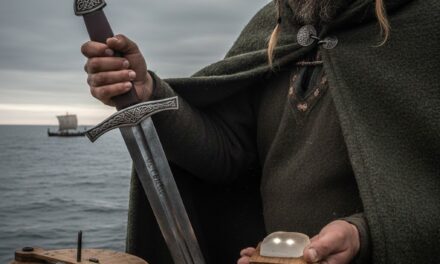
The Viking Age (roughly 793–1066 AD) wasn’t just about raiding and pillaging; it was an era of intense necessity that birthed some of the most sophisticated maritime and social engineering in history.
Several key factors forced the Norse people to innovate or fade into obscurity:
1. Geography and Land Scarcity
Scandinavia’s landscape—dominated by fjords, mountains, and dense forests—offered very little “prime” real estate for farming. As the population grew, the available arable land couldn’t support everyone.
-
The Innovation: This pushed the Norse to become masters of the sea. Since they couldn’t expand easily by land, they looked to the “water highways.”
2. Maritime Necessity: The Longship
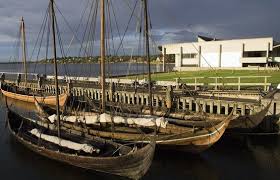 Viking Ship Museum, Roskilde, Denmark
To navigate both the choppy, deep waters of the North Atlantic and the shallow, narrow rivers of Europe (like the Seine or the Volga), the Vikings needed a vessel that didn’t exist yet.
-
The Innovation: They developed the clinker-built hull (overlapping planks) which made ships flexible enough to withstand ocean waves but light enough to be carried over land (portage).
Their shallow draft allowed them to sail right onto beaches, enabling the “hit and run” tactics they became famous for.
3. Navigation in the Open Ocean
Unlike many contemporary sailors who hugged the coastlines, Vikings traveled to Iceland, Greenland, and North America.
-
The Innovation: They likely used sunstones (calcite crystals) to locate the sun on overcast days and wooden sun compasses to determine latitude.
4. Economic Shifting and Trade
As the Vikings encountered the wealthy Carolingian Empire and the Abbasid Caliphate, they realized that raiding was high-risk, while trading was high-reward.
-
The Innovation: They created a massive transcontinental trade network.
To facilitate this, they innovated in metallurgy (specifically the Ulfberht swords which used “crucible steel” techniques far ahead of their time) and developed a bullion economy where silver was weighed rather than just counted as specific coins. -
Problem vs. Innovation
| Factor | The Challenge | The Innovative Solution |
| Demographics | Overpopulation & lack of land | Exploration and colonization |
| Travel | Deep oceans vs. shallow rivers | The Longship (variable draft) |
| Climate | Long, dark winters | Advanced wool processing & preservation |
| Warfare | Need for speed and surprise | Shield-wall tactics & specialized ironwork |
The Viking era is a classic example of “necessity is the mother of invention.” They didn’t innovate because they wanted to be modern; they innovated because their environment gave them no other choice.